
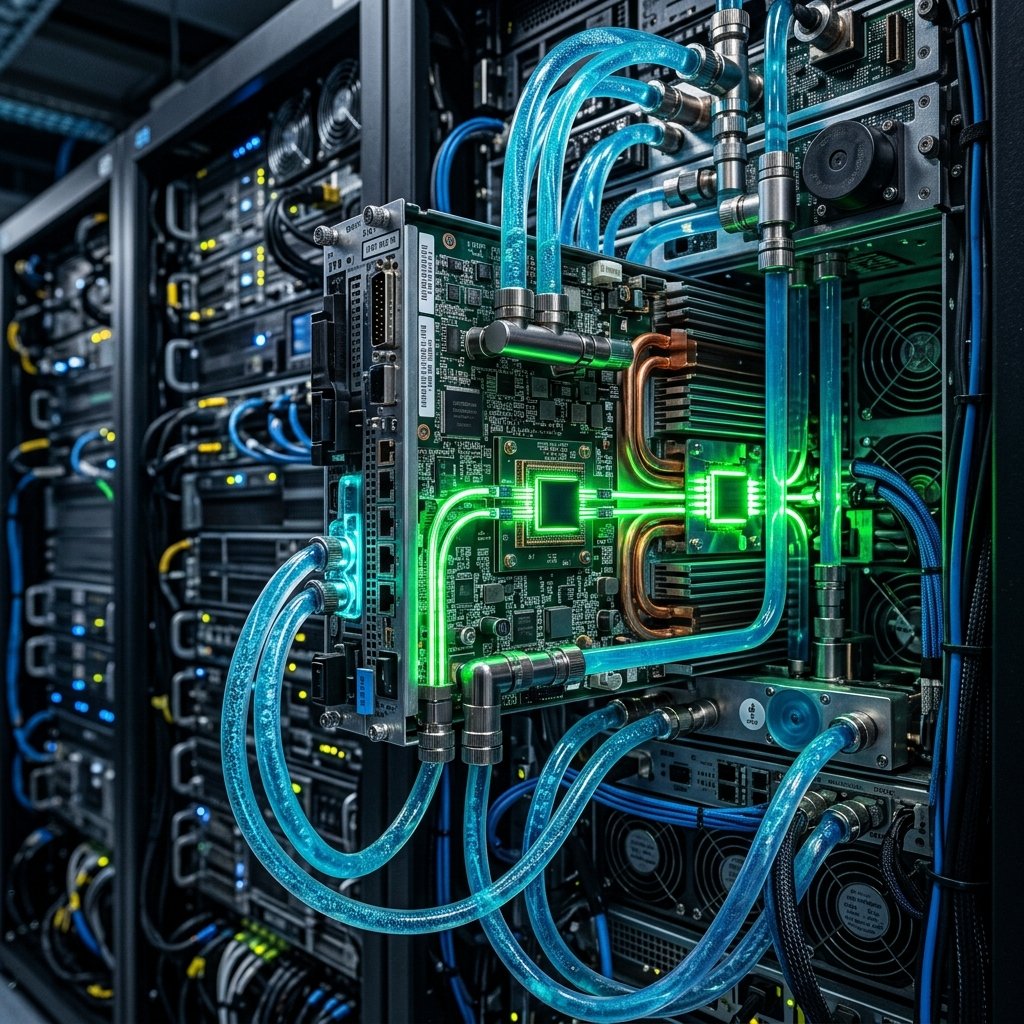
The obvious AI story is already crowded. Everyone can see GPUs, frontier models, chatbots, coding assistants, and data center demand.
This article supports the AI reorganization cycle by mapping the physical, informational, and institutional substrates that determine how AI moves beyond agents.
The more valuable question is what those visible trends depend on.
AI does not scale in the abstract. It scales through power systems, cooling loops, optical links, mineral supply chains, data pipelines, identity rails, payment systems, and trust infrastructure. The application layer gets the headlines. The substrate layer often gets the durable profit pool.
The following twelve trends share one pattern: each is an infrastructure dependency hiding behind a more fashionable story.
The Three-Tier Radar
Not every hidden trend matures on the same schedule. Some are already crossing into mainstream deployment. Others are still structural bets that require patience, bleeding into Tier 3 unpriced AI infrastructure.
| Tier | Description | Approximate Timeframe |
|---|---|---|
| Tier 1 | Near-certain infrastructure shifts already underway | 12 to 24 months |
| Tier 2 | High-conviction structural plays gaining momentum | 2 to 5 years |
| Tier 3 | Frontier bets with asymmetric upside | 5 to 10+ years |
The important point is not that every trend will mature on schedule. The important point is that each trend sits beneath a larger demand wave.
Liquid Cooling and Thermal Management
AI has created a heat problem before it has created a software utopia.
High-density AI racks are far beyond the thermal assumptions of traditional enterprise data centers. Air cooling was designed for a different era: lower rack density, lower sustained utilization, and less extreme accelerator clustering. AI workloads push facilities toward direct-to-chip liquid cooling, coolant distribution units, immersion systems, advanced plumbing, and thermal engineering that looks more industrial than digital.
The hidden opportunity is retrofitting. New AI campuses can be designed around liquid cooling from the beginning. Existing data centers are harder. They need mechanical redesign, skilled labor, water planning, uptime protection, and operational discipline.
Cooling is not a side category. It is one of the first physical gates on AI growth.
Optical Interconnects and Silicon Photonics
The bottleneck in AI is moving from inside chips to between chips.
Large AI clusters depend on moving enormous amounts of data across accelerators, memory, switches, racks, and facilities. Copper links become increasingly power-hungry and thermally difficult as speeds rise and distances matter. Optical interconnects, silicon photonics, near-package optics, and co-packaged optics are part of the industry’s answer.
This transition is not just a component upgrade. It changes test systems, packaging, reliability models, serviceability, thermal design, and manufacturing yield. That makes it a classic under-the-radar infrastructure shift: strategically important, technically complex, and easy for outsiders to ignore.
The more AI clusters scale, the more the interconnect fabric becomes the performance ceiling.
Critical Minerals
The AI supply chain depends on materials most people cannot name.
Gallium, germanium, antimony, rare earths, copper, high-purity chemicals, and specialty materials feed compound semiconductors, optics, defense electronics, power equipment, and data center hardware. Small-volume materials can become large strategic chokepoints because there are few substitutes and limited refining capacity.
This is a geopolitical trend as much as a technology trend. Export controls, reserve policies, domestic refining programs, recycling, allied sourcing, and strategic stockpiles all matter.
AI may look like software, but its supply chain reaches into mines, refineries, chemical plants, shipping lanes, and national security policy.
Enhanced Geothermal Systems
AI data centers need firm power. Solar and wind help, but intermittent generation does not solve every data center requirement. Nuclear is attractive but slow to permit and build.
Enhanced geothermal systems offer a different path: use drilling, horizontal well design, subsurface mapping, and hydraulic stimulation techniques to access heat beyond traditional geothermal hotspots.
This is why the category matters. It borrows operational knowledge from oil and gas while serving a clean baseload power need. If costs fall and projects scale, enhanced geothermal could become one of the more important power sources for energy-hungry compute campuses.
The market may still hear “geothermal” and think of old infrastructure. The strategic version is closer to a drilling technology platform.
AI Agent Identity and Digital Trust
Autonomous AI cannot safely transact without identity.
Today’s identity systems were built for humans, employees, devices, and APIs. AI agents create a harder problem. They may be temporary, delegated, scoped, revocable, and capable of taking financially meaningful actions at machine speed.
That requires a new trust layer: agent IDs, signed mandates, verifiable credentials, attestation, policy engines, just-in-time permissions, audit logs, and human step-up authentication for high-risk actions.
Agent identity is not glamorous. It is plumbing. But every scaled agent economy needs plumbing before it can handle real money, contracts, or sensitive data.
Machine-to-Machine Payments
If AI systems can discover and negotiate, they will eventually need to pay.
Machine-to-machine payments cover the rails that allow autonomous systems to purchase compute, data, services, logistics, energy, advertising, insurance, and software access without a human clicking a checkout button.
This will likely mature first in B2B contexts. Procurement, inventory management, cloud spending, API access, freight, and supplier negotiation are rule-heavy domains where machine agents can create measurable savings.
The payment layer will need spending limits, auditability, fraud controls, dispute resolution, tax treatment, and integration with identity. The winning rails will combine speed with governance.
Synthetic Data Engineering
AI has a data quality problem hiding behind a compute story.
Frontier systems have absorbed a huge portion of accessible high-quality public data. Synthetic data can help, but recursively training models on low-quality model output creates degradation risk. The future belongs to governed synthetic data pipelines, not indiscriminate AI-generated filler.
The winning synthetic data systems will generate edge cases, preserve provenance, validate distributions, include human review where needed, and maintain versioned datasets. This is especially important for agents, safety testing, robotics, medicine, finance, and regulated enterprise AI.
Data curation may become as important as model architecture.
Inference Economics and Model Compression
Training receives attention because the numbers are dramatic. Inference determines whether products survive.
Agentic systems can trigger many model calls for one user request. They reason, retrieve, verify, plan, execute, critique, and retry. Even if per-token prices fall, total workload can rise faster.
That creates a new discipline: inference economics. Companies will need model routing, distillation, pruning, quantization, semantic caching, batch optimization, hardware-aware deployment, and cost-per-outcome measurement.
The future is not always the largest model. It is the cheapest reliable system that completes the task.
Neuromorphic and Analog Computing
GPUs are powerful, but they are not the ideal answer for every kind of intelligence.
Always-on edge devices need low-power inference. Robots, drones, sensors, wearables, industrial controls, and autonomous vehicles cannot all depend on cloud-scale compute or high-energy chips.
Neuromorphic and analog approaches aim to compute more like physical systems and biological brains: event-driven, sparse, local, and efficient. These categories still face software ecosystem, reliability, manufacturing, and standardization challenges. But the need is clear.
If billions of edge devices require continuous intelligence, energy efficiency becomes the market.
Synthetic Biology and Programmable Materials
Biology is becoming a manufacturing substrate.
The early synthetic biology hype cycle overpromised. The more durable story is industrial: enzymes, specialty chemicals, self-healing materials, cell-free production, biological sensors, protein design, and distributed biomanufacturing.
AI accelerates this field by exploring molecular design spaces that humans cannot search manually. The result may not look like consumer novelty products. It may look like cheaper catalysts, better coatings, targeted therapeutics, industrial polymers, and localized production systems.
The category is slow, regulated, and technically hard. That is also why it can produce moats.
Quantum computing gets most of the attention. Quantum sensing may become useful sooner.
GPS is vulnerable to jamming, spoofing, denial, underground limits, underwater limits, and contested environments. Quantum clocks, accelerometers, magnetometers, and gravimeters can provide timing, navigation, and sensing based on physical measurements rather than external signals.
Defense will likely remain the first major customer, but commercial applications can emerge in aviation, shipping, autonomous logistics, mining, infrastructure inspection, and geophysical mapping.
The trigger is easy to imagine: a major GPS disruption that forces buyers to pay for alternatives.
Knowledge Graphs and Neuro-Symbolic AI
Pure generation is not enough for enterprise trust.
Companies need AI systems that can explain sources, follow rules, preserve context, reason over structured relationships, and withstand audits. Knowledge graphs, GraphRAG, formal rules, neuro-symbolic systems, and governed retrieval architectures address that need.
This category sounds old because knowledge graphs have been around for years. The difference is that LLMs now provide the natural language interface that older graph systems lacked.
The future enterprise AI stack is likely hybrid: language models for interaction, structured knowledge for grounding, policy engines for constraints, and audit systems for proof.
The Dependency Pattern
These trends reinforce each other. AI demand stresses power, cooling, and interconnects. Power demand supports geothermal and grid hardware. Interconnect demand supports photonics and critical minerals. Agentic commerce requires identity and payment rails. Synthetic data requires governance. Inference costs push compression. Edge intelligence creates demand for new chip architectures.
The meta-insight is simple: the AI revolution is not only a model revolution. It is a cooling revolution, optics revolution, power revolution, identity revolution, data governance revolution, and trust revolution at the same time.
What to Watch
Track announcements that are boring but binding: utility interconnection agreements, liquid-cooling retrofit contracts, optical interconnect standards, agent identity protocols, machine payment APIs, synthetic data governance frameworks, inference cost disclosures, geothermal offtake deals, and regulated AI explainability requirements.
Those signals tell you when a hidden substrate is becoming a commercial necessity, which is critical when tracking Phase 3 AI signals.
Sources and Further Reading
This article synthesizes a broad infrastructure radar. The sources below are grouped around the technical and institutional substrates discussed in the piece.
- International Energy Agency, Energy and AI. Core source for AI electricity demand, energy security, affordability, and infrastructure planning.
- Open Compute Project, Cooling Environments. Supports the liquid-cooling, cold-plate, CDU, immersion, and heat-reuse sections.
- Tom’s Hardware, Nvidia outlines plans for using light for communication between AI GPUs by 2026. Supports the silicon photonics and co-packaged optics discussion.
- arXiv, Next-generation Co-Packaged Optics for Future Disaggregated AI Systems. Provides technical background on CPO, optical I/O, and disaggregated AI systems.
- U.S. Geological Survey, Mineral Commodity Summaries. Supports the critical-minerals section.
- U.S. Department of Energy, Enhanced Geothermal Systems. Supports the enhanced-geothermal explanation and baseload-power discussion.
- Anthropic, Introducing the Model Context Protocol. Supports the agent identity and tool-integration sections.
- Associated Press, Visa plugs its payment network into ChatGPT, letting AI agents shop and pay for users. Supports the machine-to-machine and agentic-commerce payment discussion.
- arXiv, The Curse of Recursion: Training on Generated Data Makes Models Forget. Provides technical grounding for synthetic-data degradation and model-collapse risk.
- arXiv, Retrieval-Augmented Generation with Graphs. Supports the knowledge-graph and GraphRAG section.
- arXiv, Graph Retrieval-Augmented Generation: A Survey. Provides additional grounding for graph-enhanced retrieval and structured reasoning.
- Intel, Intel Builds World’s Largest Neuromorphic System to Enable More Sustainable AI. Supports the neuromorphic-computing section.
- United Nations Institute for Training and Research and ITU, The Global E-waste Monitor 2024. Supports the e-waste, recycling, and resource-recovery discussion.
FAQ
What are under-the-radar AI infrastructure trends?
They are less visible technologies and systems that AI depends on, including cooling, optics, power, identity, payments, data quality, compression, materials, and trust infrastructure.
Why is liquid cooling important for AI?
AI accelerators create dense heat loads that traditional air cooling often cannot handle efficiently. Liquid cooling helps facilities support higher rack densities and sustained workloads.
Why do AI agents need identity infrastructure?
Agents need scoped permissions, verifiable authority, audit trails, and revocation if they are going to act on behalf of people or companies.
What is inference economics?
Inference economics is the management of the recurring cost of running AI systems in production, especially when agentic workflows require many model calls per task.
Why are knowledge graphs returning?
Knowledge graphs help ground AI in structured relationships, traceable sources, and governed reasoning, which enterprises need for reliability and compliance.