
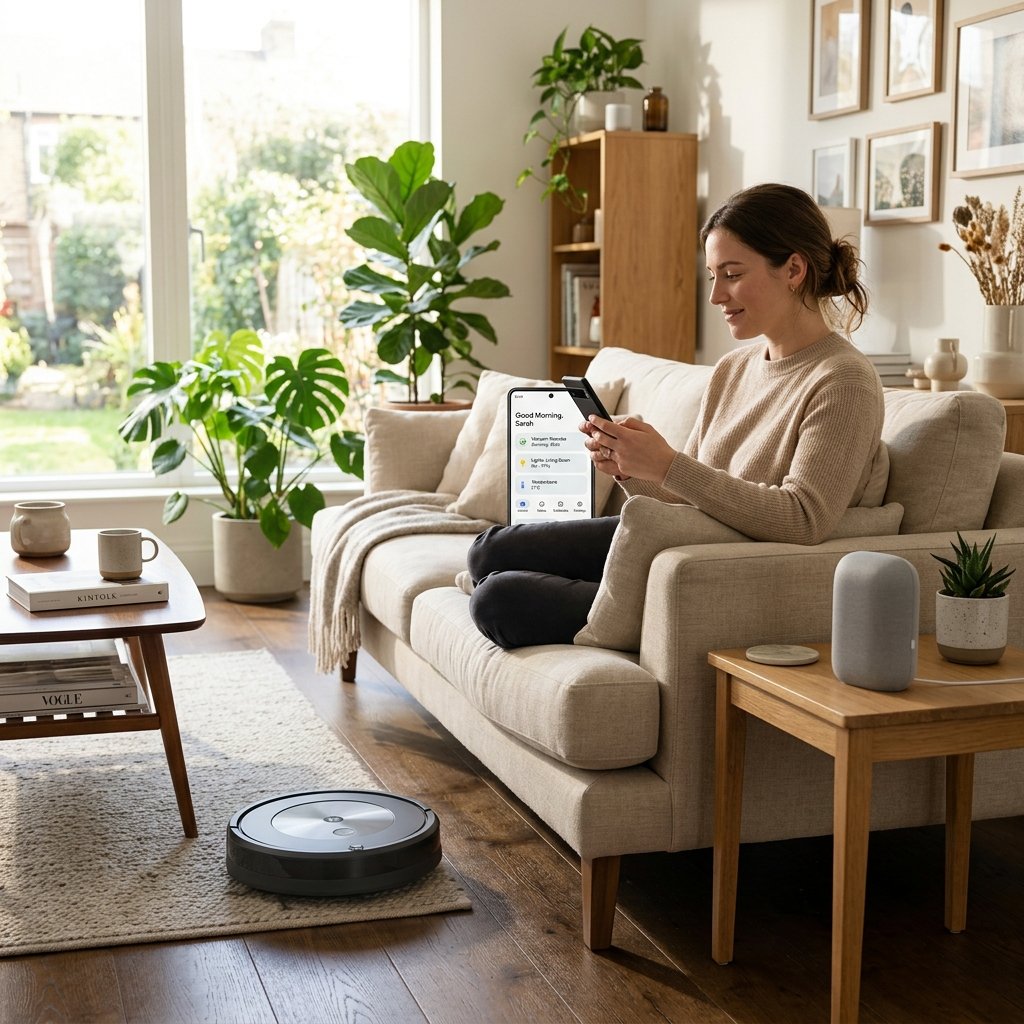
AI in everyday life is no longer about chatbots. It is about the appliances, vehicles, health devices, financial tools, grocery systems, energy grids, and personal services that are absorbing intelligence without asking for a prompt.
This article extends the AI reorganization cycle into the consumer layer. The original series focused on enterprise infrastructure, agent consolidation, and machine-to-machine commerce. This piece asks a different question: what does AI reorganization look like in the products and services that ordinary people touch every day?
The answer is quieter than the headlines suggest. The most durable consumer AI will not be the product you open on purpose. It will be the intelligence embedded in things you already use — your thermostat, your car, your refrigerator, your insurance policy, your running shoes, your pharmacy, and your grocery delivery.
Most people will never call it AI. They will just notice that things work better.
Why Consumer AI Is Different
Enterprise AI gets attention because the spending is visible. Companies announce budgets, contracts, partnerships, and deployment timelines. The numbers are large and the narratives are clear.
Consumer AI is harder to track because it disappears into existing products. A washing machine that adjusts its cycle based on fabric weight and water quality does not market itself as an AI product. A car insurance policy that adjusts premiums based on real-time driving data does not feel like a technology revolution. A grocery app that reorders staples before you run out does not require a prompt.
This is the difference between AI as a product and AI as a feature. The enterprise market is still largely buying AI as a product. The consumer market is increasingly receiving AI as a feature embedded in something they already pay for.
That distinction matters because it changes what "AI adoption" looks like from the outside. The historical pattern of technology absorption predicts exactly this: the most transformative phase is not when people start using a new tool, but when they stop noticing it.
The Consumer Phase Map
How is AI used in everyday life? The same five-phase sequence that governs enterprise adoption also applies to consumer products and services. The phases just look different at home.
| Phase | Enterprise Expression | Consumer Expression |
|---|---|---|
| Substitution | AI answers support tickets | AI answers your search query |
| Amplification | AI drafts sales emails faster | AI writes your grocery list faster |
| Reorganization | AI replaces the workflow | AI replaces the app |
| Emergence | Machine-to-machine procurement | Your car negotiates its own insurance |
| Ambient | AI becomes invisible infrastructure | Your home manages itself |
Most consumer AI today sits in Phase 1 and early Phase 2. You ask a chatbot a question. You use an AI camera filter. You get an AI-generated playlist. You dictate a text message. These are substitution and amplification: old tasks, slightly improved.
The interesting shift begins in Phase 3, when the product stops waiting for you to act.
The Kitchen and the Laundry Room
Home appliances are one of the clearest examples of AI in everyday life because the use cases are so mundane that nobody calls them AI.
A modern washing machine can weigh the load, detect fabric type, measure water hardness, adjust detergent dosage, select cycle duration, and optimize water temperature. None of that requires a prompt. The machine senses and adapts.
Refrigerators with internal cameras can track inventory, suggest recipes based on what is available, flag expiration dates, and generate shopping lists. Ovens can identify food through cameras and adjust cooking time and temperature automatically.
These are not novelty features. They are early examples of intent-driven appliances. The user declares an outcome — clean clothes, fresh food, a cooked meal — and the appliance handles the steps.
The Phase 3 version goes further. The appliance coordinates with other systems. The washing machine checks electricity pricing and runs during off-peak hours. The refrigerator sends a restocking order to a delivery service. The oven communicates with a ventilation system to manage air quality.
The home stops being a collection of isolated devices and starts becoming a coordinated system.
The Car Becomes a Platform
The automobile is likely the most AI-dense consumer product most people will own.
Modern vehicles already contain driver-assistance systems, adaptive cruise control, lane-keeping, automatic emergency braking, parking assistance, voice control, predictive navigation, and over-the-air software updates. Many drivers use these features without thinking of them as artificial intelligence.
The next phase is not about adding more features to the dashboard. It is about the car becoming an operating environment.
A Phase 3 vehicle manages its own maintenance schedule based on sensor data, driving patterns, and component wear. It negotiates insurance rates based on real-time risk. It selects charging times based on grid pricing and battery health. It adjusts its suspension, steering, and throttle response based on road conditions, weather, and driver behavior.
A Phase 4 vehicle participates in machine-to-machine commerce. It pays for tolls, parking, charging, and road-use fees autonomously. It communicates with other vehicles and infrastructure to optimize traffic flow. It negotiates with repair shops for parts and labor.
The car does not become a robot. It becomes an economic agent with wheels.
Health Monitoring Without a Doctor Visit
Health is one of the areas where examples of AI in everyday life are accumulating fastest, and where the stakes are highest.
Wearable devices already track heart rate, blood oxygen, sleep stages, skin temperature, step count, and stress indicators. Newer sensors are adding continuous glucose monitoring, blood pressure estimation, respiratory analysis, and menstrual cycle prediction.
The Phase 2 version of health AI shows you a dashboard. You open an app, look at your data, and decide what to do.
The Phase 3 version acts on your behalf. A health system notices that your resting heart rate has been elevated for three days, your sleep quality has declined, and your activity has dropped. It adjusts your schedule, suggests a rest day, flags a possible issue, and books a telehealth appointment if the pattern continues.
The Phase 4 version coordinates with other systems. Your health data informs your grocery recommendations, adjusts your home lighting for better sleep, modifies your exercise plan, and updates your insurance risk profile.
The sensitivity of health data makes this one of the most regulated and contested areas of consumer AI. Privacy, consent, liability, and data ownership are not solved problems. But the trajectory is clear: health monitoring moves from episodic and clinic-based to continuous and ambient.
Personal Finance Becomes Adaptive
Money management is already one of the most active consumer AI categories, even if most people do not frame it that way.
Banks use AI to detect fraud, flag unusual transactions, categorize spending, forecast cash flow, suggest savings transfers, and personalize credit offers. Investment platforms use AI for portfolio rebalancing, tax-loss harvesting, risk profiling, and retirement projections.
The Phase 2 version of this sends you a notification: "You spent more on dining this month than last month." That is amplification. It makes old financial reporting faster.
The Phase 3 version acts within boundaries you set. Your financial system automatically moves surplus cash into a higher-yield account, negotiates a lower interest rate on a recurring subscription, cancels a free trial before it converts to a paid plan, and rebalances your portfolio based on declared risk tolerance.
The Phase 4 version manages your financial relationships autonomously. Your AI proxy negotiates insurance renewal, compares utility rates, switches providers when a better deal appears, handles warranty claims, and disputes billing errors — all within constraints you define.
This is the consumer version of the Phase 3 AI signals discussed in the enterprise series. The difference is that the "enterprise" is your household.
Grocery, Retail, and the Disappearing Shopping Trip
Grocery shopping is a daily-life activity where AI reorganization is already visible.
Recommendation engines suggest products based on purchase history. Delivery services optimize routing and timing. Inventory systems predict demand and reduce waste. Dynamic pricing adjusts offers based on supply, seasonality, and customer behavior.
The Phase 3 grocery experience removes the shopping trip entirely for staple goods. Your pantry inventory is tracked through connected devices or purchase history. Replenishment happens automatically. Substitutions follow your dietary preferences and budget constraints. Delivery windows are optimized around your schedule.
Retail beyond groceries follows a similar path. Clothing may be recommended based on body measurements, past preferences, weather forecasts, and calendar events. Returns may be handled by an AI proxy that manages logistics, refunds, and exchanges without manual intervention.
The shopping experience does not disappear. It splits. Exploration and discovery remain human pleasures. Routine procurement becomes a background service.
Home Energy and Climate Control
A home energy system is one of the most natural places for AI to reorganize daily life, because energy management is a problem of optimization under constraints — exactly what AI does well.
Smart thermostats already learn occupancy patterns, adjust temperature based on time of day, and respond to weather forecasts. But these are Phase 2 behaviors: amplification of an existing control.
The Phase 3 version manages the home as an energy system. Solar generation, battery storage, grid pricing, EV charging, HVAC load, hot water heating, and appliance scheduling are coordinated as a single optimization problem. The system does not just learn your preferences. It actively trades energy, shifting consumption to low-price periods, selling stored power back to the grid during peak demand, and pre-cooling the house before an afternoon rate spike.
This turns every home with solar, storage, and smart devices into a micro-utility. The AI does not replace the homeowner’s judgment about comfort. It handles the economic and engineering decisions that most people neither want nor have time to manage.
Education and Learning
AI is beginning to change how people learn outside of formal institutions.
Language learning apps already use AI to adapt difficulty, correct pronunciation, personalize vocabulary, and simulate conversation partners. Educational platforms adjust pacing based on performance. Tutoring systems identify weak areas and provide targeted practice.
The Phase 3 version creates personalized learning paths that adapt not just to performance but to motivation, attention patterns, preferred modalities, and life context. A parent learning a new skill gets a different curriculum than a college student, even for the same subject.
The Phase 4 version connects learning to professional systems. A certification earned through an AI tutor is verified, added to a credential wallet, and surfaced to relevant employers or clients. The learning system and the professional system talk to each other.
Entertainment and Media
Entertainment is already one of the most AI-saturated consumer categories.
Streaming services recommend content based on viewing history, time of day, mood signals, and social patterns. Music platforms generate playlists, discover new artists, and adapt to context. Social media feeds are algorithmically curated. Video games adjust difficulty in real time.
The Phase 3 shift is not better recommendations. It is generated content. AI can create personalized stories, interactive experiences, adaptive game worlds, custom music, and entertainment that does not exist until the moment you engage with it.
This raises difficult questions about creativity, authorship, quality, and manipulation. But for the average consumer, the experience is straightforward: entertainment becomes more responsive, more personalized, and more abundant.
The countertrend is also real. As AI-generated content becomes cheap, human-made art, live performance, and authentic creative work may become more valuable precisely because they are scarce.
Personal Safety and Security
AI is quietly becoming the first line of defense in personal security.
Home security cameras use AI to distinguish between people, animals, vehicles, and weather events. Doorbells identify known visitors. Phones detect spam calls and phishing attempts. Email filters block sophisticated scams. Banking apps flag suspicious transactions.
The Phase 3 version creates a defensive AI layer — what the series calls a personal AI firewall. This system does not just detect threats. It acts on your behalf: blocking robocalls before they ring, verifying the identity of senders before messages reach your inbox, reviewing contracts for predatory terms, and monitoring your digital footprint for identity theft.
As synthetic voices, deepfake video calls, and AI-generated phishing become more convincing, the need for a defensive AI proxy becomes more urgent. The irony is clear: the best defense against AI-powered attacks is AI-powered defense.
The Invisible Layer
The common thread across all of these examples of AI in everyday life is disappearance.
AI in daily life does not look like a robot or a chatbot or a dashboard. It looks like a washing machine that just works better, a car that just drives more safely, a thermostat that just saves money, a pharmacy that just refills on time, and a bank that just protects you from fraud.
This is the ambient phase that the five-phase sequence predicts. Electricity disappeared into walls. The internet disappeared into phones. AI will disappear into products and services.
The word "artificial" will eventually feel strange. Intelligence will just be a property of the environment, like temperature or light.
What Could Go Wrong
Consumer AI carries risks that enterprise AI often avoids.
Privacy erosion is the most obvious. A home that monitors everything — energy, food, health, spending, movement, sleep, and conversation — creates a detailed behavioral profile. Who owns that profile? Who can access it? Who profits from it?
Manipulation is the second risk. AI systems that learn your preferences can also exploit them. A financial AI that knows your spending weaknesses can nudge you toward purchases that benefit the platform. A health AI can create anxiety to sell supplements. An entertainment AI can maximize engagement at the cost of wellbeing.
Dependency is the third risk. As systems automate more daily decisions, human skills atrophy. A generation that never learns to cook, navigate, budget, or troubleshoot may become fragile when the AI layer fails.
Digital inequality is the fourth risk. If ambient AI becomes expensive, it could create a world where wealthy households live in intelligent environments while others are excluded.
These risks are not reasons to avoid consumer AI. They are reasons to demand transparency, portability, regulation, and genuine consumer control over the systems that manage daily life.
The Signal to Watch
The consumer AI shift becomes structural when three things happen simultaneously.
First, major appliance and device manufacturers stop marketing AI as a feature and start treating it as assumed infrastructure. When Samsung, Apple, Tesla, LG, and Bosch stop saying "now with AI" and start saying nothing at all, the ambient phase has arrived.
Second, consumers start paying for defensive AI. When people subscribe to a service that protects them from other AI systems — scam filtering, contract review, identity protection, negotiation proxies — the market has acknowledged that AI is not just a convenience but an environment.
Third, interoperability emerges. When your car, home, health devices, financial accounts, and shopping services can share data through a common, user-controlled layer, the home becomes a system rather than a collection of apps.
None of these transitions will announce themselves. The loudest AI announcements are usually Phase 1. The quiet ones are Phase 3.
Sources and Further Reading
This article draws on consumer technology trends, survey data, and the adoption framework developed across the AI reorganization cycle series.
- Goodwater Capital, 2026 U.S. Consumer Survey on AI’s Role in Everyday Life. Documents AI’s growing integration into daily consumer experiences.
- TD Bank, 2026 AI Insights Report: Artificial Intelligence at the Consumer Inflection Point. Reports that over 78% of Americans use AI-powered tools in daily life.
- Adobe, 2026 AI and Digital Trends: Customer Behaviors and AI. Tracks AI as an everyday companion across search, shopping, and customer support.
- Ipsos, Artificial Intelligence: Key Insights, Data and Tables. Provides public opinion data on AI in shopping, services, and daily decision-making.
- K&L Gates, AI Product Liability: The Next Wave of Litigation. Discusses the legal liability framework emerging around AI-enabled consumer products.
- International Energy Agency, Energy and AI. Supports the home energy and smart grid discussion.
- Paul A. David, "The Dynamo and the Computer". Provides the historical productivity-paradox framework applied to consumer technology adoption.
FAQ
How is AI used in everyday life?
AI is used in everyday life through smartphone assistants, recommendation engines, navigation apps, fraud detection, smart home devices, health wearables, personalized shopping, and adaptive entertainment platforms.
What are examples of AI in everyday life?
Examples include smart thermostats that learn your schedule, washing machines that adjust cycles automatically, cars with driver-assistance systems, banks that detect fraudulent transactions, streaming services that recommend content, and health devices that monitor vital signs continuously.
Will AI replace daily tasks?
AI is more likely to absorb routine tasks into the background — automatic reordering, schedule management, bill negotiation, energy optimization, and health monitoring — than to replace activities that involve judgment, creativity, or social interaction.
What are the risks of AI in everyday products?
The main risks include privacy erosion from continuous monitoring, manipulation by systems that know behavioral patterns, dependency as skills atrophy, and digital inequality if ambient AI becomes available only to wealthier consumers.
What is ambient AI?
Ambient AI is intelligence embedded into the physical environment — homes, vehicles, infrastructure, and devices — that operates continuously without requiring user prompts, screens, or conscious interaction.