
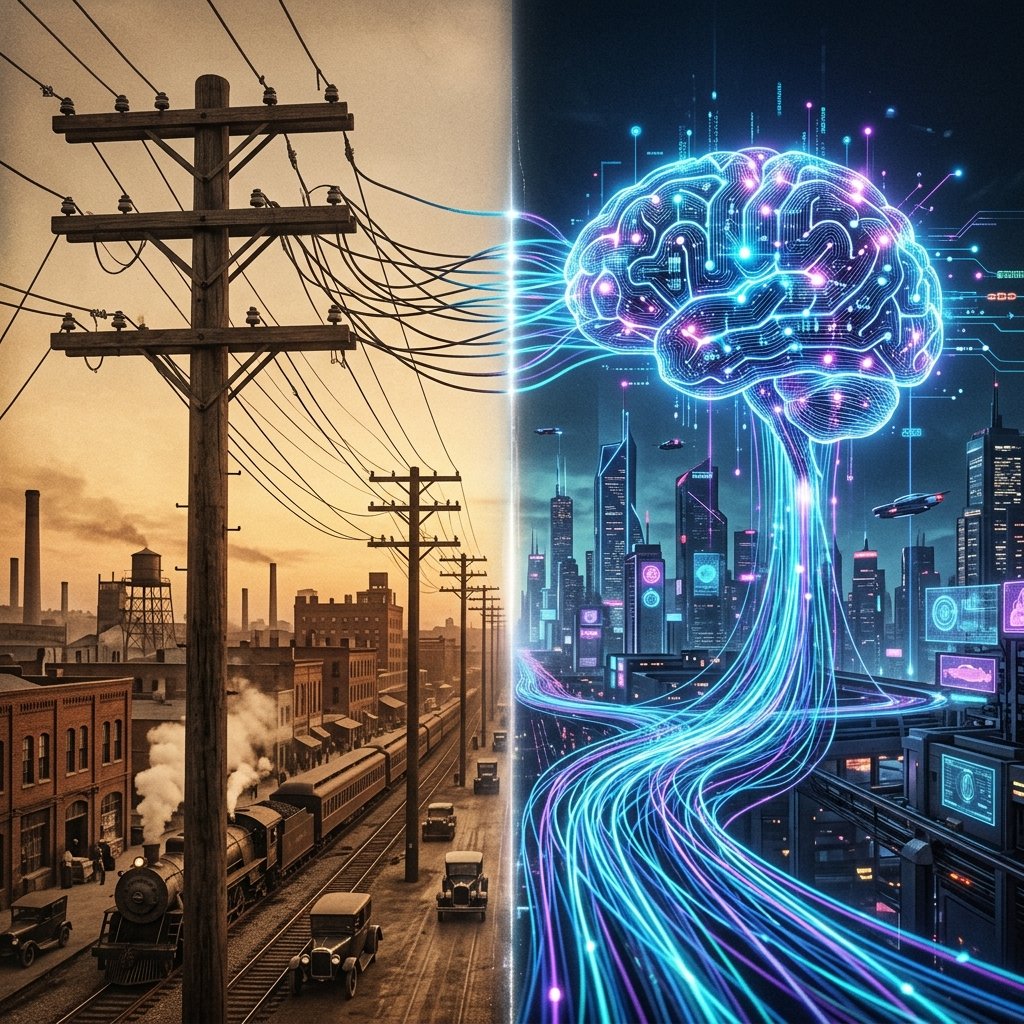
General purpose technology adoption follows a recurring pattern: substitution, amplification, reorganization, emergence, and ambient adoption.
This article provides the historical foundation for the AI reorganization cycle, Prediction Oracle’s pillar guide to AI adoption phases, agent consolidation, infrastructure bottlenecks, and Phase 3 AI signals.
Every unlocking technology feels unprecedented while it is happening. Electricity felt like magic. The internet felt like a rupture. Artificial intelligence feels like a new species of tool.
But human behavior is less original than the technology itself.
When a general purpose technology arrives, society tends to absorb it through the same five-phase sequence: substitution, amplification, reorganization, emergence, and ambient adoption. We first use the new tool to do old things. Then we use it to do old things faster. Only later do we rebuild institutions around what the technology uniquely makes possible.
That delay is where the opportunity hides.
The Five-Phase Sequence
The sequence is not a law of physics, but it is a strong historical pattern.
| Phase | Human Behavior | Strategic Meaning |
|---|---|---|
| Substitution | Do the old thing with the new tool | Familiar use cases dominate |
| Amplification | Do the old thing faster, cheaper, or bigger | Hype rises, productivity disappoints |
| Reorganization | Rebuild the system around the tool’s strengths | Native winners emerge |
| Emergence | Discover capabilities with no old-world analogue | Civilizational effects compound |
| Ambient | Stop noticing the technology | The tool becomes infrastructure |
The money, power, and disruption usually concentrate in phases three and four. The attention usually concentrates in phases one and two.
That mismatch is the universal blind spot.
Electricity Began as a Better Candle
Electricity did not begin by reorganizing civilization. It began by replacing light.
The first obvious use case was illumination. Arc lamps replaced gas lamps in streets and factories. Incandescent bulbs replaced candles and oil lamps in homes. The pitch was direct and practical: same light, cleaner and safer.
This is substitution. The technology is new, but the mental model is old.
Nobody looked at the early light bulb and immediately saw skyscrapers, air conditioning, refrigeration, mass broadcasting, home appliances, and the modern city. Those came later because society needed time to stop thinking of electricity as better fire.
The Electric Factory Had to Be Rebuilt
The second phase of electricity was amplification. Factory owners bought electric motors and attached them to the same central drive shafts that steam engines had powered.
The building stayed the same. The workflow stayed the same. The factory remained organized around a central mechanical spine. Electricity was inserted into steam-era architecture.
The productivity gains were disappointing because the system had not changed. The breakthrough came with unit drive: small electric motors attached to individual machines.
That shift sounds simple, but it destroyed the old architecture. Factories no longer had to be built around one central shaft. Machines could be arranged according to workflow. Production could move across single-story layouts. Machines could start and stop independently. The assembly line became practical.
Electricity did not merely improve the factory. It changed what a factory was.
Electricity Then Created the Impossible
Once electricity became infrastructure, it produced inventions that were not better candles.
Elevators helped make skyscrapers practical. Refrigeration created the cold chain and changed food logistics. Air conditioning reshaped where people could live and work. Radio created mass broadcast communication. Home appliances changed domestic labor and helped alter workforce participation.
These were phase four effects. They were not obvious from the first use case. They emerged after the system reorganized around the new physics of controllable, transmissible, always-available energy.
By the ambient phase, nobody thought of flipping a light switch as “using electricity.” It simply became how the world worked.
The Internet Repeated the Pattern
The early internet was also substitution.
Websites were digital brochures. Newspapers uploaded versions of print editions. Email behaved like faster mail or faster fax. Online catalogs mirrored offline catalogs. The new medium was treated as a cheaper distribution channel for old formats.
Then came amplification. Companies did the same businesses online, just bigger and faster. Amazon was first legible as an online bookstore. eBay looked like a garage sale everyone could attend. Newspapers added comment sections and updates but kept the old publishing model.
Capital rushed in because the potential was visible. But many companies were still Phase 2 businesses priced as if they had already reached Phase 4. The dot-com crash was not an accident. It was a structural feature of the transition.
Internet-Native Winners Reorganized the World
After the crash, the surviving and emerging companies rebuilt around the internet’s native strengths: zero marginal distribution cost, real-time coordination, network effects, user-generated content, persistent identity, and algorithmic matching.
Netflix did not become a better Blockbuster. It became a streaming and recommendation architecture. Uber did not become a better taxi dispatcher. It became real-time supply-demand matching. Airbnb did not become a hotel chain. It became a network of unused capacity. Google did not become a better Yellow Pages. It became intent-based search and advertising infrastructure.
The winners did not bolt the internet onto old organizations. They built from the medium outward.
Then came emergent effects: social media, cloud computing, smartphones, the gig economy, algorithmic feeds, creator platforms, open-source coordination, and internet-native trust experiments.
Again, the first-order use case was not the main event.
AI Is Now Leaving Substitution
AI’s first phase looked exactly like the pattern predicts.
ChatGPT wrote emails faster. Image models replaced stock photos. Coding tools autocompleted snippets. Customer service bots answered tickets. Summarizers shortened documents. The old workflows remained intact.
That was AI as a faster typewriter, faster camera, faster research assistant, faster call center, and faster IDE.
By 2025 and 2026, AI moved into amplification. Companies began generating more content, reviewing more documents, producing more sales outreach, screening more drug candidates, and automating existing workflows through agents.
This creates real value. It also creates the productivity paradox. A company can spend heavily on AI while leaving the org chart, process map, incentive system, approval chain, and customer experience unchanged.
New intelligence running through old architecture produces smaller gains than the market wants.
The AI Reorganization Phase
The real AI breakthrough begins when companies stop asking, “How can AI improve this process?” and start asking, “What would this system look like if intelligence were abundant?”
That question leads to different designs.
Departments become less fixed. Teams form around missions and dissolve when the mission is complete. Decision rights move closer to the data. Software becomes adaptive instead of static. Products become generated experiences. Business functions scale up or down with demand. AI systems negotiate with other AI systems.
The unit-drive equivalent for AI is intelligence per function, per task, per transaction, and per environment. Instead of one central decision hierarchy, every meaningful process gains embedded judgment.
That is the reorganization phase.
What AI May Make Possible
Emergence is harder to forecast because it produces things that sound strange before the infrastructure exists.
AI could create personalized education that adapts to each student in real time. It could create personal science labs that design and evaluate experiments autonomously. It could coordinate supply chains as living systems. It could generate software interfaces only when needed. It could help discover materials, drugs, proteins, and industrial processes by searching design spaces no human team could manually explore.
It could also create defensive personal proxies, machine-to-machine commerce, ambient health systems, self-healing infrastructure, and collective reasoning systems for groups.
None of these are simply better chatbots. They are second-order effects of abundant cognition.
Why the Bubble Risk Is Real
Technology bubbles tend to form when capital prices Phase 4 outcomes into Phase 2 companies.
The electricity era had speculative manias and consolidation. The internet had the dot-com frenzy. AI has its own version: enormous funding for companies that wrap generic models around familiar workflows.
Some of those companies will become important. Many will disappear in an AI consolidation event, or be absorbed into larger platforms.
The more durable opportunity lies with companies that reorganize systems around AI-native assumptions and with the infrastructure providers that remove the bottlenecks.
The Actionable Question
The wrong question is: how can AI make my current process faster?
The better question is: if intelligence were cheap, instant, and everywhere, what would I build from scratch?
That question forces a move from substitution and amplification into reorganization. It exposes inherited architecture. It reveals where workflows exist only because humans were once the bottleneck.
Every unlocking technology rewards the builders who stop imitating the past first.
Sources and Further Reading
This article is a historical interpretation of general purpose technology adoption. The sources below support the productivity-paradox, techno-economic-cycle, and reorganization arguments used throughout the piece.
- Paul A. David, “The Dynamo and the Computer: An Historical Perspective on the Modern Productivity Paradox”. A foundational source for the delayed productivity impact of electrification and the analogy to computing.
- Carlota Perez, publications and research on technological revolutions and techno-economic paradigms. Supports the installation/deployment, frenzy, bubble, and reorganization framing.
- Wikipedia summary, Technological Revolutions and Financial Capital. Useful background on Perez’s technology-cycle model and its relationship to financial bubbles.
- Wikipedia summary, Productivity paradox. Provides background on the Solow productivity paradox and later information-technology adoption debate.
- Anthropic, Introducing the Model Context Protocol. A current AI-era example of the move from isolated tools toward reusable infrastructure.
- International Energy Agency, Energy and AI. Supports the argument that AI adoption depends on earlier physical and digital infrastructure layers.
FAQ
What is a general purpose technology?
A general purpose technology is a foundational capability that affects many industries and enables broad waves of complementary innovation, such as electricity, the internet, and artificial intelligence.
What are the five phases of technology adoption?
The five phases are substitution, amplification, reorganization, emergence, and ambient adoption.
Where is AI in the five-phase sequence?
AI appears to be in late substitution and early amplification, with reorganization beginning in more advanced companies and infrastructure layers.
Why do early productivity gains disappoint?
Early gains disappoint because organizations often insert new technology into old workflows rather than rebuilding the system around the technology’s strengths.
Where is the biggest opportunity in AI adoption?
The biggest opportunity is likely in AI-native reorganization and in the infrastructure bottlenecks that make large-scale AI deployment possible.