
The obvious AI infrastructure trades are no longer obscure.
This article extends the AI reorganization cycle into second-order infrastructure constraints that may matter after the first wave of data center buildout.
While under-the-radar AI infrastructure trends like advanced cooling and optical networking are now widely discussed, that does not mean they are finished. It means the easy information advantage has narrowed.
Second-level thinking asks a different question: if Tier 1 AI infrastructure is already visible, what constraints become urgent after the current buildout matures?
The answer may sit in businesses that look too boring for the AI narrative: e-waste recycling, oilfield drilling, proprietary physical data, and industrial water management.
The Time-Arbitrage Edge
Many large investors operate on quarterly pressure. They prefer catalysts that fit into earnings cycles, analyst notes, and visible demand curves.
That creates a time-arbitrage opportunity for slower constraints. If a bottleneck is mathematically likely but commercially important three or four years from now, the market may underprice it today.
AI infrastructure is full of those slow constraints. Hardware becomes obsolete. Water becomes political. Power becomes local. Data quality becomes scarce. Drilling expertise becomes relevant to geothermal. Mineral reclamation becomes more strategic as supply chains tighten.
The key is to look for capabilities that the AI industry will need before the market starts calling them AI companies.
E-Waste and Mineral Reclamation
AI hardware cycles are brutal.
Accelerators, networking gear, memory, servers, and power systems can become economically obsolete long before they physically stop working. As each generation of AI hardware improves, older systems are retired, resold, repurposed, or scrapped.
That creates a future e-waste wave. Inside discarded data center hardware are valuable and strategically important materials: copper, gold, rare earths, specialty metals, circuit boards, power components, and potentially recoverable critical inputs.
Reclamation becomes attractive for two reasons. First, mining and refining new material can be slow, expensive, and geopolitically exposed. Second, data center retirement cycles may create concentrated streams of high-value waste.
Specialized recyclers and metallurgical processors could become more important if they can handle complex electronics, comply with environmental rules, recover high-value materials efficiently, and serve enterprise customers that need auditable disposal.
Companies worth researching in this category include Sims Limited and Umicore. The broader thesis is not about any single name. It is about the possibility that “scrap” becomes a strategic supply chain.
Deep-Earth Drilling and the Geothermal Pivot
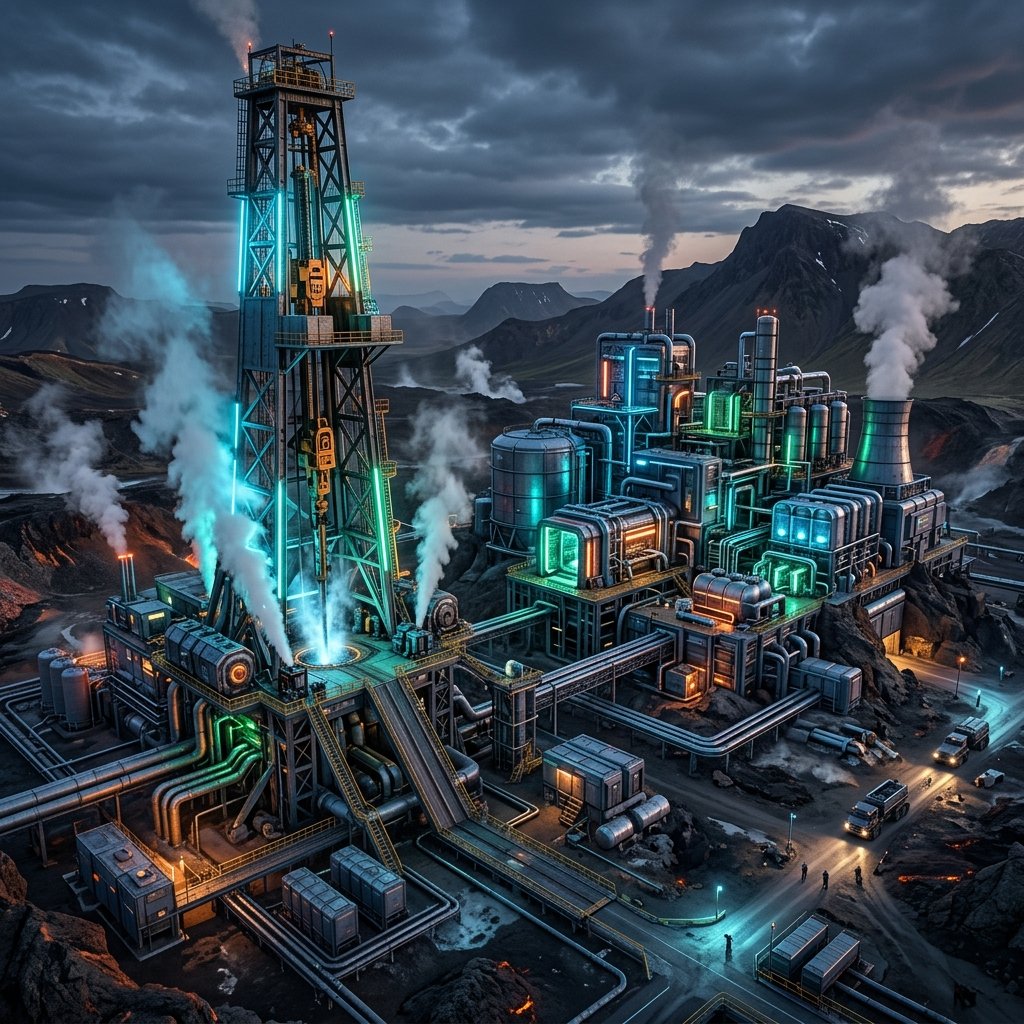
AI data centers need firm power. Nuclear is attractive but slow. Gas is dispatchable but carbon-exposed. Solar and wind help but require storage and transmission. Enhanced geothermal systems offer another path.
Enhanced geothermal depends on drilling capability. That creates a bridge between oilfield services and clean baseload power.
The oil and gas industry already has expertise in subsurface mapping, horizontal drilling, high-temperature materials, well design, hydraulic stimulation, pressure management, and field operations. Those capabilities can transfer into geothermal projects as technology and demand mature.
This is the second-level insight: some companies priced as oilfield service providers may also become infrastructure suppliers to AI-era power demand.
Baker Hughes, SLB, and Halliburton are examples for research because they possess relevant drilling and subsurface capabilities. The question is whether geothermal revenue becomes meaningful enough to change how the market values those capabilities.
Proprietary Physical Data
The internet is filling with synthetic content. That makes verifiable real-world data more valuable.
AI systems trained on low-quality synthetic material risk degradation, bias amplification, and loss of diversity. The more synthetic the public web becomes, the more valuable proprietary, validated, high-friction data becomes.
High-friction data is difficult to scrape, hard to fake, legally controlled, and tied to physical or institutional reality. Examples include actuarial records, insurance claims, scientific literature, legal databases, property risk models, laboratory measurements, genomic data, medical records, industrial sensor feeds, and materials testing data.
Companies that own trusted data assets may become more important in AI even if they are not seen as AI-native.
Verisk and RELX are examples of proprietary institutional data businesses. Agilent and Illumina represent a different angle: instruments and workflows that generate physical-world scientific and biological data. The core thesis is that grounded data becomes scarcer as synthetic data becomes abundant.
Industrial Water Management
AI infrastructure is not only an electricity story. It is also a water story.
Data centers use water through cooling systems, power generation dependencies, humidification, and operational needs. Liquid cooling can reduce some facility-level burdens but increases the importance of water quality, closed-loop management, treatment, leak prevention, and thermal exchange design.
In arid regions, water becomes political. Data centers can compete with agriculture, households, industry, and municipal planning. Even when direct water use is reduced, public perception and permitting risk matter.
That creates demand for industrial water recycling, purification, monitoring, closed-loop systems, and wastewater reuse.
Ecolab and Xylem are examples for further research because they operate in water treatment, industrial efficiency, monitoring, and infrastructure. The broader point is that water governance may become a gating factor for compute expansion in constrained regions.
Why These Categories Are Easy to Miss
These categories do not sound like AI.
Recycling sounds like waste management. Drilling sounds like legacy energy. Proprietary databases sounds like old information services. Water treatment sounds like municipal infrastructure.
That is exactly why they deserve attention. The market often re-rates capabilities only after the new demand source becomes obvious.
AI will not only reward companies that build models. It may reward companies that solve the least glamorous constraints in the physical stack.
The Watchlist Framework
A Tier 3 infrastructure idea should pass four tests.
First, the constraint should be tied to a large AI demand curve. Second, the capability should be hard to build quickly. Third, the current market narrative should still treat the company or sector as boring, legacy, or unrelated. Fourth, there should be a plausible catalyst within three to five years.
That framework does not guarantee an investment outcome. It does help separate genuine second-order infrastructure from loose AI theming.
Conclusion
The most crowded AI trades follow the headlines. The less crowded ones follow the constraints.
E-waste, geothermal drilling, proprietary physical data, and industrial water management may not look like the future from a distance. But each maps to a real pressure point in the AI buildout: materials, power, data quality, and resource permitting.
The durable question is simple: what will the AI industry desperately need that the market still prices as boring as we move beyond agents into the Phase 5 horizon?
Sources and Further Reading
This article discusses market themes and company examples for further research, not investment recommendations. The sources below support the infrastructure constraints behind the thesis.
- United Nations Institute for Training and Research and ITU, The Global E-waste Monitor 2024. Supports the e-waste and mineral-reclamation thesis, including global e-waste volumes, recycling rates, and recoverable resource value.
- U.S. Geological Survey, Mineral Commodity Summaries. Provides authoritative mineral supply, production, import, and critical-material context.
- U.S. Department of Energy, Enhanced Geothermal Systems. Supports the geothermal drilling discussion and explains EGS reservoir creation, permeability, and power generation.
- International Energy Agency, Energy and AI. Supports the macro premise that AI data center growth is creating new energy-system planning requirements.
- Lawrence Berkeley National Laboratory, 2024 United States Data Center Energy Usage Report. Provides U.S. data center energy-demand context for the broader infrastructure buildout.
- Open Compute Project, Cooling Environments. Supports the industrial cooling and water-management discussion.
- arXiv, Environmental Burden of United States Data Centers in the Artificial Intelligence Era. Useful background on energy, electricity-source, and carbon-impact analysis for U.S. data center expansion.
FAQ
What is Tier 3 AI infrastructure?
Tier 3 AI infrastructure refers to less obvious constraints that may become strategically important after the first wave of chips, data centers, cooling, and power investment.
Why does e-waste matter for AI?
Fast hardware replacement cycles can create large streams of valuable electronic waste, making mineral recovery and auditable recycling more important.
How does geothermal relate to AI?
AI data centers need firm power. Enhanced geothermal could provide clean baseload electricity if drilling technology and project economics improve.
Why is proprietary physical data valuable?
As public data becomes saturated with synthetic content, verified real-world datasets become more useful for training, validation, and grounded AI systems.
Why is water management an AI infrastructure issue?
Data centers and power systems can create water demand and local permitting pressure, especially in arid or politically sensitive regions.