
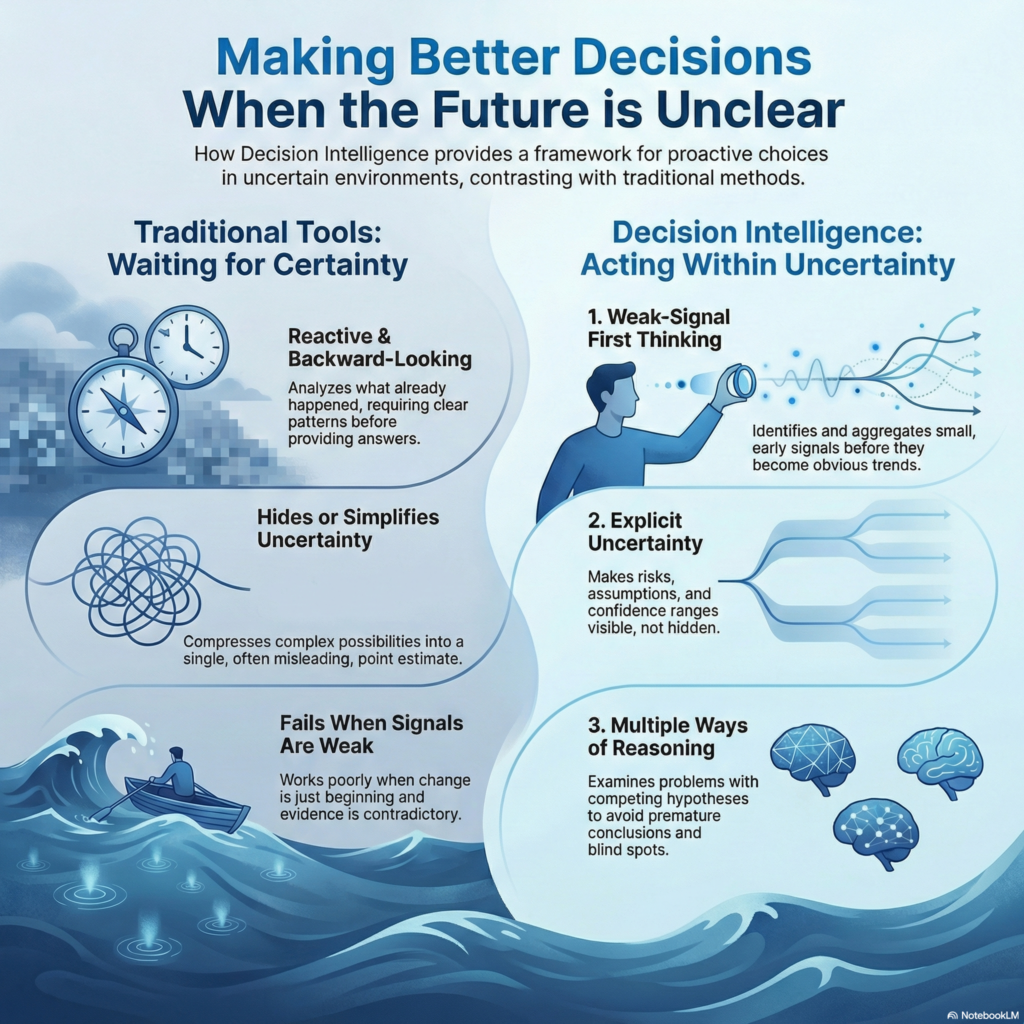
Making Better Decisions When the Future Is Unclear
What if you could make better decisions before the data becomes clear?
Decision intelligence is not about predicting the future. It’s about making better decisions when the future is unclear — when information is incomplete, signals conflict, and the cost of being wrong can be high.
In the real world, decisions are rarely made with perfect data. Leaders, builders, and operators are forced to act while evidence is partial, trends are emerging, and outcomes remain uncertain.
Traditional decision-making tools often struggle in these moments. They are designed for clarity after the fact, not ambiguity in the present.
Decision intelligence exists to help people reason clearly in the face of uncertainty rather than pretending it isn’t there. It recognizes that uncertainty is not a temporary flaw in the data — it is a permanent feature of complex systems.
This perspective is grounded in Uncertainty-First Decision Theory, which provides the theoretical foundation for treating uncertainty as an informational asset rather than an obstacle to decision-making.
Prediction Oracle is built specifically for this reality.
Learning Objectives
By reading this article, you will:
- Understand what decision intelligence is and how it differs from traditional prediction and forecasting
- Learn the three pillars of decision intelligence: weak-signal first thinking, explicit uncertainty, and multiple ways of reasoning
- Discover how Prediction Oracle applies these principles through Polymorphic Intelligence
- Identify when decision intelligence is most valuable for your strategic decision-making needs
- Recognize the difference between decision support systems and traditional analytics tools
Time Investment: 10-15 minutes
Prerequisites: None — suitable for decision-makers at all levels
Expected Outcome: Clear understanding of decision intelligence and its practical applications
Why Traditional Decision-Making Tools Fall Short
Most tools used for strategic decision-making today are optimized for certainty and confirmation:
- Dashboards summarize what already happened
- Forecasts compress uncertainty into a single number
- KPIs and metrics lag behind real-world change
These tools are useful — but only once patterns are established and direction is clear.
They work poorly when:
- Signals are weak, fragmented, or contradictory
- Change is just beginning and is hard to measure
- Decisions are long-horizon, irreversible, or high-stakes
In these moments, waiting for clarity often means waiting too long. By the time consensus forms, the range of options has narrowed, and the cost of action has increased.
This is where decision intelligence matters most: before certainty arrives.
Decision Intelligence vs. Traditional Decision-Making Tools
| Aspect | Traditional Tools | Decision Intelligence |
|---|---|---|
| Timing | Reactive — analyzes past data | Proactive — detects early signals |
| Uncertainty Handling | Compresses into single estimates | Makes uncertainty explicit with ranges |
| Signal Detection | Requires strong, clear signals | Works with weak, fragmented signals |
| Decision Support | Provides answers after patterns emerge | Creates options before consensus forms |
| Use Cases | Established patterns, clear direction | Emerging trends, ambiguous situations |
| Risk Management | Often hidden or simplified | Explicitly surfaces risks and exposure |
Decision Intelligence vs. Prediction and Forecasting
Prediction asks a narrow question:
What is most likely to happen?
Decision intelligence asks a broader and more practical question:
What could happen, how uncertain are we, and what should we be ready for if it does?
Instead of optimizing for forecast accuracy alone, decision intelligence frameworks optimize for:
- Timing — acting early enough to preserve options
- Preparedness — readiness for multiple scenarios
- Option creation — maintaining flexibility as conditions evolve
- Risk and exposure awareness — understanding what could go wrong
Being exactly right is less important than being early enough to act, test assumptions, and preserve flexibility.
This approach aligns with research on decision-making under uncertainty and robust decision-making frameworks used in complex systems analysis.
How Prediction Oracle Approaches Decision Intelligence
Prediction Oracle treats decision intelligence as a system rather than a single model or output.
At the core of this system is Polymorphic Intelligence — the ability to examine the same emerging trend, prediction, or potential black swan event through multiple independent reasoning modes before collapsing anything into a conclusion.
Rather than searching for a single correct answer, the system is designed to support structured thinking in the face of uncertainty. It combines several complementary ideas to produce decision-grade clarity.
Polymorphic Intelligence and Decision Intelligence Documents
Polymorphic Intelligence is the mechanism Prediction Oracle uses to turn uncertainty into Decision Intelligence Documents.
Instead of generating a single forecast or narrative, the system intentionally applies different reasoning lenses to the same body of weak signals and data exhaust. Each lens asks a different question:
- What trend might be forming?
- What are the competing explanations?
- What could break this thesis?
- What would a true black swan look like here?
These lenses operate in parallel, not in sequence. Their outputs are compared, challenged, and reconciled only where evidence supports convergence.
The result is not a prediction, but a structured Decision Intelligence Document that includes:
- Multiple hypotheses about how a trend could evolve
- Explicit probability ranges instead of point estimates
- Clear assumptions and known unknowns
- Early-warning signals tied to each possible path
- Black swan scenarios that sit outside the base case but cannot be ignored
These documents are meant to be revisited over time. As new signals arrive, probabilities shift, assumptions are tested, and scenarios are updated — allowing decision-makers to stay oriented as reality changes.
Polymorphic Intelligence enables Prediction Oracle to handle trends, forecasts, and black swans within the same framework without forcing false certainty.
The Three Pillars of Decision Intelligence
1. Weak-Signal First Thinking
Real-world example (Business):
A company notices subtle changes long before revenue or KPIs move: a slowdown in enterprise deal cycles, a shift in the types of questions customers ask, and an increase in competitor hiring for adjacent roles.
None of these signals proves a downturn on its own. Together, they suggest changing buyer behavior months before it shows up in quarterly numbers.
Decision intelligence doesn’t wait for confirmation. It treats early signals as reasons to explore scenarios, stress-test assumptions, and prepare options while action is still inexpensive.
Major changes rarely appear suddenly. They form gradually through small, easy-to-ignore signals that are often dismissed as noise.
1.1 Identifying Weak Signals
Prediction Oracle is designed to surface those early indicators across diverse domains, including:
- Research and technical communities
- Organizational and hiring shifts
- Regulatory and policy movement
- Supply-chain and vendor behavior
- Practitioner conversations and workflows
1.2 Signal Aggregation and Pattern Recognition
Individually, these signals don’t prove anything. Taken together, they provide early context about what may be forming, long before changes become obvious or measurable.
This approach to weak signal detection is grounded in research on early warning systems and strategic foresight methodologies.
2. Explicit Uncertainty
Real-world example (Technology):
A product team evaluating a new AI capability sees mixed evidence. Early adopters are enthusiastic, performance benchmarks look promising, but reliability data is limited, and regulatory guidance is unclear.
A traditional forecast might collapse this into a single adoption estimate. A decision intelligence approach makes uncertainty explicit: which assumptions are being made, what risks exist if reliability lags, and what is still unknown.
Instead of one confident projection, leaders see ranges, trade-offs, and failure modes — and can decide how much to invest without pretending the risk isn’t there.
2.1 Making Uncertainty Visible
Most systems hide uncertainty to appear confident and decisive. Prediction Oracle does the opposite.
Every analysis explicitly surfaces uncertainty by identifying:
- Key assumptions — what must be true for the analysis to hold
- Confidence ranges instead of point estimates
- Known unknowns — what we acknowledge we don’t know
- Areas of disagreement or conflicting interpretation
2.2 Uncertainty as Information
Uncertainty is not treated as a weakness of the analysis. It is treated as information — something decision-makers should see, understand, and account for.
This approach aligns with decision theory research showing that explicit representation of uncertainty improves decision quality in complex environments.
3. Multiple Ways of Reasoning
Real-world example (Policy):
When evaluating a proposed regulation, policymakers often face conflicting inputs: economic models suggesting minimal impact, industry warnings about compliance costs, and advocacy groups highlighting downstream effects.
A single narrative oversimplifies reality. Decision intelligence preserves multiple interpretations at once — best-case, worst-case, and unintended consequences — allowing decision-makers to see where risks concentrate and where assumptions could break.
Disagreement becomes part of the analysis, not something to resolve prematurely.
3.1 Applying Multiple Reasoning Lenses
Instead of forcing a single narrative, Prediction Oracle applies multiple reasoning lenses to the same question, including:
- Competing hypotheses — different explanations for the same evidence
- Base, upside, and downside scenarios — range of possible outcomes
- Second-order effects and knock-on consequences
- Failure modes and edge cases
3.2 Preserving Disagreement
Disagreement is preserved until evidence supports convergence. This approach reduces the risk of premature certainty and helps expose blind spots hidden by overly confident conclusions.
This methodology draws from scenario planning and red team analysis techniques used in strategic planning and risk management.
What Decision Intelligence Produces
Decision intelligence is not a recommendation engine and not an answer generator.
Oracle outputs for predictions are designed to support, not replace, human judgment. They focus on:
- Decision variables that actually matter
- Available options and trade-offs
- Risk and exposure under different scenarios
- Signals worth monitoring as conditions evolve
The goal is decision readiness — the ability to act thoughtfully as reality unfolds — not reassurance or false confidence.
A System That Learns From Outcomes
Decision intelligence only works if it improves over time.
Prediction Oracle incorporates feedback by tracking:
- What was anticipated
- What actually happened
- Where confidence was misplaced
- Where blind spots existed
This feedback loop allows the system to calibrate its reasoning and improve future analyses.
Most organizations move on quickly and forget past decisions.
This system is designed to remember.
Who Decision Intelligence Is For
Decision intelligence is most valuable for people who:
- Make long-horizon or high-impact decisions
- Operate in uncertain, complex, or fast-changing environments
- Prefer clarity over comfort
- Want to be early, not just right
That includes investors, entrepreneurs, business owners, executives, operators, researchers, and serious independent thinkers who understand that uncertainty is unavoidable — but mismanaging it is not.
The Bottom Line: Why Decision Intelligence Matters Now
Decision intelligence doesn’t promise certainty.
It provides clarity under uncertainty.
Prediction Oracle exists to help people:
- See the change earlier
- Think more clearly about risk and exposure
- Prepare before the consensus forms
Because in complex systems, the real advantage isn’t knowing the future.
It’s knowing when to act.
Conclusion
Decision intelligence is ultimately about respecting reality as it is, not as we wish it to be.
In complex systems, uncertainty is unavoidable, signals arrive early and quietly, and waiting for certainty often means surrendering choice. Tools that simplify too aggressively or promise confidence where none exists may feel comforting — but they often fail when the stakes are highest.
Prediction Oracle represents a different posture toward decision-making. It is designed to help people notice what others overlook, think clearly in the presence of ambiguity, and prepare for multiple plausible futures without locking into a single narrative too early.
The value of decision intelligence is not prediction accuracy. It is optionality — having time, perspective, and awareness when decisions still have room to move.
In an environment where change is faster than consensus and information arrives long before clarity, the advantage belongs to those who can see earlier, reason better, and act deliberately.
That is the role decision intelligence is meant to play — and the problem Prediction Oracle was built to solve.
Frequently Asked Questions
What is the difference between decision intelligence and business intelligence?
Business intelligence focuses on analyzing historical data to understand what happened. Decision intelligence focuses on using weak signals and uncertainty to make better decisions about what might happen. While BI helps you understand the past, decision intelligence helps you act in the present despite an uncertain future.
How does decision intelligence handle conflicting signals?
Decision intelligence preserves multiple interpretations rather than forcing premature resolution. It uses multiple reasoning lenses to examine the same evidence from different angles, allowing decision-makers to see where risks concentrate and where assumptions might break. Disagreement becomes part of the analysis, not something to eliminate.
Can decision intelligence be automated?
Decision intelligence supports human judgment rather than replacing it. While Prediction Oracle automates the process of detecting weak signals, surfacing uncertainty, and applying multiple reasoning frameworks, the final decisions remain with human decision-makers who bring context, values, and judgment that systems cannot replicate.
What industries benefit most from decision intelligence?
Decision intelligence is most valuable for industries facing:
- High uncertainty and rapid change
- Long-horizon, high-stakes decisions
- Weak or conflicting signals
- Complex, interconnected systems
This includes technology, finance, healthcare, energy, and policy sectors, though any organization making strategic decisions under uncertainty can benefit.
How does decision intelligence differ from predictive analytics?
Predictive analytics typically produces point estimates (e.g., “sales will be $10M next quarter”). Decision intelligence produces probability ranges, multiple scenarios, and explicit uncertainty (e.g., “sales likely between $8-12M, with 30% chance of regulatory changes affecting outcomes”). Decision intelligence optimizes for decision readiness, not just forecast accuracy.
What makes a good Decision Intelligence Document?
A strong Decision Intelligence Document includes:
- Multiple hypotheses about how trends could evolve
- Explicit probability ranges instead of point estimates
- Clear assumptions and known unknowns
- Early-warning signals tied to each possible path
- Black swan scenarios outside the base case
See our guide on how to read Decision Intelligence Documents for more details.
How often should Decision Intelligence Documents be updated?
Decision Intelligence Documents are designed to be revisited as new signals arrive. Probabilities shift, assumptions are tested, and scenarios are updated — allowing decision-makers to stay oriented as reality changes. The frequency depends on the rate of change in your domain, but quarterly reviews are typically a minimum.
Does decision intelligence require special software or tools?
While Prediction Oracle provides a systematic framework, the core principles of decision intelligence can be applied with any tool that helps you:
- Detect and aggregate weak signals
- Make uncertainty explicit
- Consider multiple scenarios
- Track early-warning indicators
The value is in the approach, not necessarily the specific technology.
How do I know if decision intelligence is right for my situation?
Decision intelligence is most valuable when:
- You make long-horizon or high-impact decisions
- You operate in uncertain, complex, or fast-changing environments
- You prefer clarity over false comfort
- You want to be early, not just right
If you’re making decisions with perfect data and clear patterns, traditional tools may suffice. If you’re acting despite uncertainty, decision intelligence can help.
Can decision intelligence help with investment decisions?
Yes. Decision intelligence is particularly valuable for investment decisions because they often involve:
- Long time horizons with high uncertainty
- Weak signals that precede market movements
- Multiple competing scenarios
- High stakes with irreversible consequences
The framework helps investors see change earlier, think more clearly about risk and exposure, and prepare before consensus forms.
Next Steps
Ready to apply decision intelligence to your strategic decisions?
Explore Decision Intelligence Documents
See decision intelligence in action by reviewing our Decision Intelligence Document for Emerging AI Trends 2026, which demonstrates how the framework handles complex, uncertain scenarios.
Learn How to Read Decision Intelligence Documents
Understand how to extract maximum value from Decision Intelligence Documents with our practical guide: How to Read Decision Intelligence Documents.
Use the Decision Checklist
Put decision intelligence into practice with our Decision Checklist, which helps you make better decisions under uncertainty by defining exposure, pre-committing to triggers, and maintaining flexibility.
Understand Uncertainty Management
Deepen your understanding of how to work with uncertainty in our Uncertainty Summary for Emerging AI Trends 2026, which shows how uncertainty is explicitly managed in decision intelligence.
Additional Resources
- Robust Decision-Making Framework — RAND Corporation research on decision-making under deep uncertainty
- Decision Theory — Stanford Encyclopedia of Philosophy: Academic foundations of decision analysis
- Scenario Planning — Strategic planning methodology for uncertain futures
- Early Warning Systems — Research on detecting weak signals
Related Articles: